Hans Fredrik Sunde

Hans Fredrik Sunde

I am a postdoctoral researcher at the Centre for Fertility and Health, Norwegian Institute of Public Health, where I work on a project called PARMENT – Parenthood, childlessness, and mental health in times of falling fertility.

I primarily investigate causes and consequences of partner similarity (such as assortative mating), and its consequences for social differences, mental health, and genetic methodology. I also investigate associations between social differences and mental health across generations, attempting to differentiate selection and causation. My interests include behavioral genetics, psychology, statistics, philosophy of science, and methodological issues in social science.

I have a PhD in psychology, which I attained when I defended my dissertation Reproduction of socioeconomic differences and mental health across generations the spring of 2024 at the University of Oslo’s (UiO) Department of Psychology. Previously, I have a master’s degree in psychology from the Norwegian University of Science and Technology (NTNU), which specialized on learning; brain, behavior and environment.

Follow me on LinkedIn, BlueSky (@hfsunde.bsky.social), and the other place (@hfsunde).

Selected papers

First page of the published article

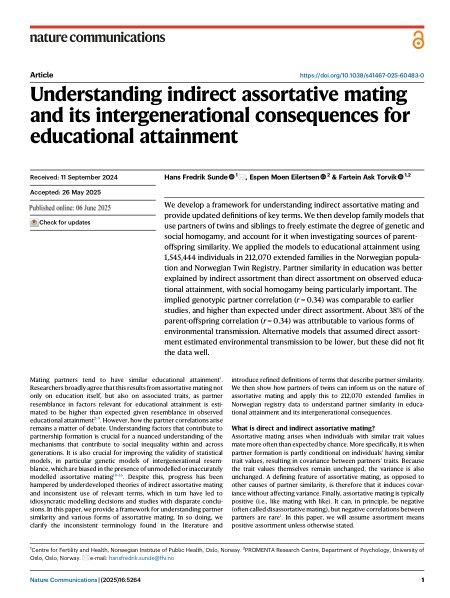
Understanding indirect assortative mating and its intergenerational consequences for educational attainment

Sunde, H.F., Eilertsen, E.M., & Torvik, F.A. (2025). Nature Communications.

Abstract

We develop a framework for understanding indirect assortative mating and provide updated definitions of key terms. We then develop family models that use partners of twins and siblings to freely estimate the degree of genetic and social homogamy, and account for it when investigating sources of parent-offspring similarity. We applied the models to educational attainment using 1,545,444 individuals in 212,070 extended families in the Norwegian population and Norwegian Twin Registry. Partner similarity in education was better explained by indirect assortment than direct assortment on observed educational attainment, with social homogamy being particularly important. The implied genotypic partner correlation (r = 0.34) was comparable to earlier studies, and higher than expected under direct assortment. About 38% of the parent-offspring correlation (r = 0.34) was attributable to various forms of environmental transmission. Alternative models that assumed direct assortment estimated environmental transmission to be lower, but these did not fit the data well.

First page of the published article

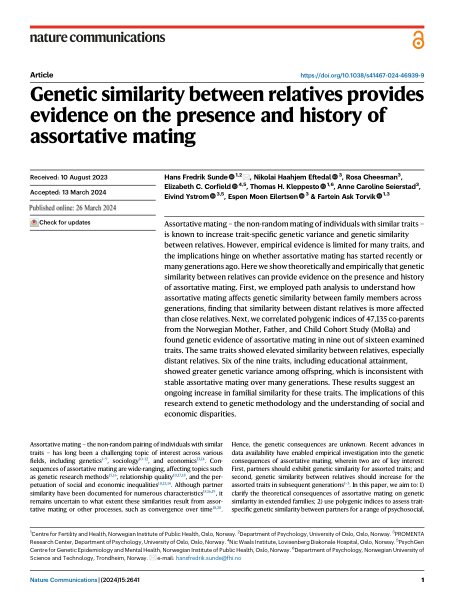
Genetic similarity between relatives provides evidence on the presence and history of assortative mating

Sunde, H.F., Eftedal, N.H., Cheesman, R., Corfield, E.C., Kleppestø, T.H., Seierstad, A.C., Ystrom, E., Eilertsen, E.M., & Torvik, F.A. (2024). Nature Communications.

Abstract

Assortative mating – the non-random mating of individuals with similar traits – is known to increase trait-specific genetic variance and genetic similarity between relatives. However, empirical evidence is limited for many traits, and the implications hinge on whether assortative mating has started recently or many generations ago. Here we show theoretically and empirically that genetic similarity between relatives can provide evidence on the presence and history of assortative mating. First, we employed path analysis to understand how assortative mating affects genetic similarity between family members across generations, finding that similarity between distant relatives is more affected than close relatives. Next, we correlated polygenic indices of 47,135 co-parents from the Norwegian Mother, Father, and Child Cohort Study (MoBa) and found genetic evidence of assortative mating in nine out of sixteen examined traits. The same traits showed elevated similarity between relatives, especially distant relatives. Six of the nine traits, including educational attainment, showed greater genetic variance among offspring, which is inconsistent with stable assortative mating over many generations. These results suggest an ongoing increase in familial similarity for these traits. The implications of this research extend to genetic methodology and the understanding of social and economic disparities.

First page of the published article

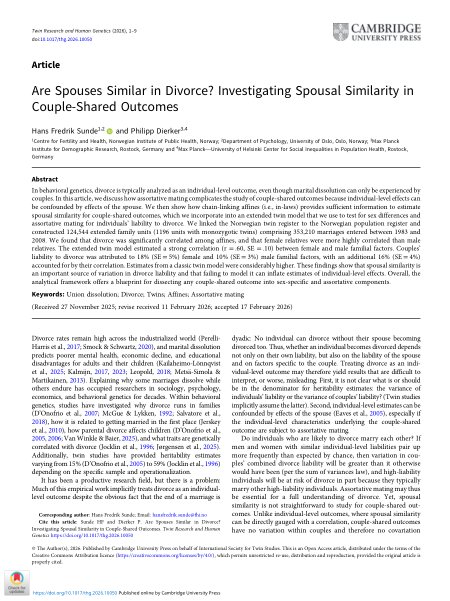
Are Spouses Similar in Divorce? Investigating Spousal Similarity in Couple-Shared Outcomes

Sunde, H.F., & Dierker, P. (2026). Twin Research and Human Genetics.

Abstract

In behavioral genetics, divorce is typically analyzed as an individual-level outcome, even though marital dissolution can only be experienced by couples. In this article, we discuss how assortative mating complicates the study of couple-shared outcomes because individual-level effects can be confounded by effects of the spouse. We then show how chain-linking affines (i.e., in-laws) provides sufficient information to estimate spousal similarity for couple-shared outcomes, which we incorporate into an extended twin model that we use to test for sex differences and assortative mating for individuals’ liability to divorce. We linked the Norwegian twin register to the Norwegian population register and constructed 124,544 extended family units (1196 units with monozygotic twins) comprising 353,210 marriages entered between 1983 and 2008. We found that divorce was significantly correlated among affines, and that female relatives were more highly correlated than male relatives. The extended twin model estimated a strong correlation (r = .60, SE = .10) between female and male familial factors. Couples’ liability to divorce was attributed to 18% (SE = 5%) female and 10% (SE = 3%) male familial factors, with an additional 16% (SE = 4%) accounted for by their correlation. Estimates from a classic twin model were considerably higher. These findings show that spousal similarity is an important source of variation in divorce liability and that failing to model it can inflate estimates of individual-level effects. Overall, the analytical framework offers a blueprint for dissecting any couple-shared outcome into sex-specific and assortative components.

First page of the published article

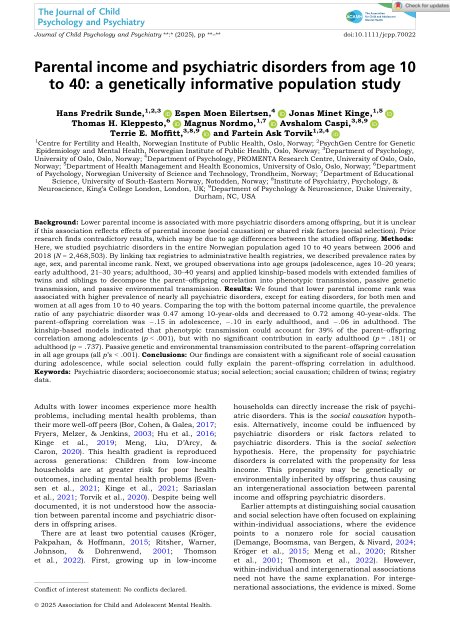
Parental income and psychiatric disorders from age 10 to 40: a genetically informative population study

Sunde, H.F., Eilertsen, E.M., Kinge, J.M., Kleppestø, T.H., Nordmo, M., Caspi, A., Moffitt, T.E., & Torvik, F.A. (2026). Journal of Child Psychology and Psychiatry.

Abstract

Background. Lower parental income is associated with more psychiatric disorders among offspring, but it is unclear if this association reflects effects of parental income (social causation) or shared risk factors (social selection). Prior research finds contradictory results, which may be due to age differences between the studied offspring.

Methods. Here, we studied psychiatric disorders in the entire Norwegian population aged 10 to 40 years between 2006 and 2018 (N = 2,468,503). By linking tax registries to administrative health registries, we described prevalence rates by age, sex, and parental income rank. Next, we grouped observations into age groups (adolescence, ages 10–20 years; early adulthood, 21–30 years; adulthood, 30–40 years) and applied kinship‐based models with extended families of twins and siblings to decompose the parent–offspring correlation into phenotypic transmission, passive genetic transmission, and passive environmental transmission.

Results. We found that lower parental income rank was associated with higher prevalence of nearly all psychiatric disorders, except for eating disorders, for both men and women at all ages from 10 to 40 years. Comparing the top with the bottom paternal income quartile, the prevalence ratio of any psychiatric disorder was 0.47 among 10‐year‐olds and decreased to 0.72 among 40‐year‐olds. The parent–offspring correlation was −.15 in adolescence, −.10 in early adulthood, and −.06 in adulthood. The kinship‐based models indicated that phenotypic transmission could account for 39% of the parent–offspring correlation among adolescents (p < .001), but with no significant contribution in early adulthood (p = .181) or adulthood (p = .737). Passive genetic and environmental transmission contributed to the parent–offspring correlation in all age groups (all p’s < .001).

Conclusions. Our findings are consistent with a significant role of social causation during adolescence, while social selection could fully explain the parent–offspring correlation in adulthood.

See all publications